
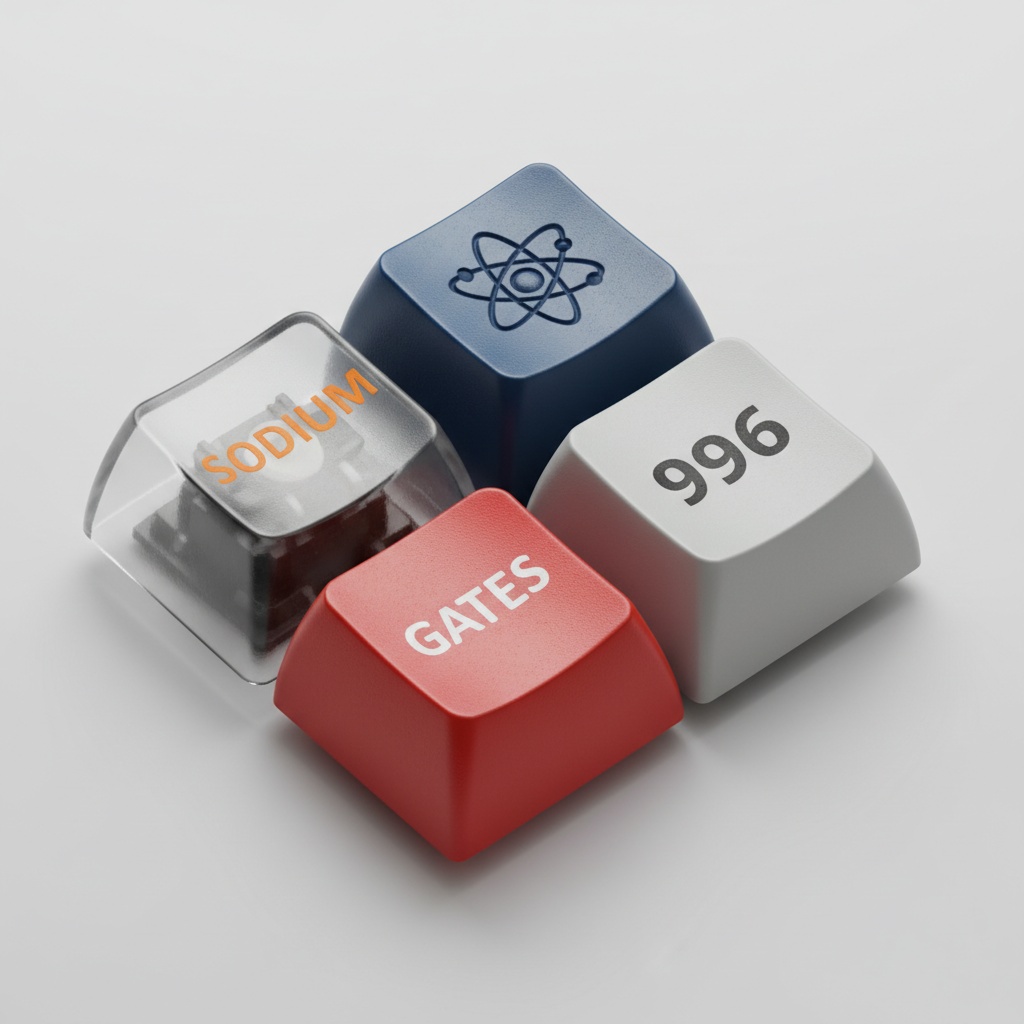
The Billionaire's Bet: Fusion, Sodium, and the Price of 996
What is the ethical and infrastructural cost of winning the global race for energy and AI dominance?
Key Takeaways
Fusion power remains perpetually out of reach because reactors require a Q-factor of 50 for efficiency and lack a scalable infrastructure for breeding tritium fuel.
Bill Gates' TerraPower secured US approval for a fast neutron reactor that uses highly reactive molten sodium as a coolant to enable continuous operation.
The '996' work culture (72 hours/week) is being revived in US startups, justified by founders as necessary for elite compensation and competitive survival.
Digest Info

The Billionaire's Energy Pipe Dream: Why Fusion is Still 50 Years Away
Tech billionaires like Gates and Bezos are pouring money into fusion projects, but the science remains stalled. The core challenge is reaching a Q factor of 50 for efficiency and solving the massive infrastructural problem of breeding tritium fuel at scale, which currently only produces grams per year.
“For those of you in American schools who never learned about any of this, nuclear power works with fission... but fusion works like the sun does.”
Is that anywhere on the horizon or is that just a pipe dream?
Well, it's, you know, for a long time, for more than 50 years, they said it was 50 years away.
Now they're like AGI, right?
And that's sort of a 20 is 20 years away thing.
There is some progress meeting made spots either is getting close to first light.
The fact that Commonwealth Fusion is working on the Rebco-based magnetic coils, which are much more powerful for making a smaller tokamak that's capable of it.
Tri-Alpha Energy out of Western Washington with their pinch design is interesting.
And many have tech billionaires behind them.
Gates is in on a Commonwealth Fusion, I think.
Oh, yeah.
Bezos is involved with Tri Alpha.
There's involvement everywhere.
Well, these guys have more money than God.
They can afford to spend a few billion on highly speculative things.
It's very hip to have your own nuclear fusion project as a tech billionaire.
They have gains.
And for those of you in American schools who never learned about any of this, nuclear power works with fission, just like a nuclear bomb, splitting up atoms and creating highly radioactive side effects.
But fusion works like the sun does, which is by breaking down larger molecules into small particles.
This is taking hydrogen atoms and making them into helium atoms and helium.
So they're harmless in other words.
Helium into lithium, lithium into beryllium, and it breaks down when you get to iron and your star goes red giant and everything dies.
The big difference, of course, is the sun uses gravity to do its fusion.
And if we try and do that, we lose the planet, which is not a good outcome.
We're trying to do magnetic containment.
You want a way of creating energy that doesn't take more energy to...
work than it creates.
And at this point with fusion, we're trying to get the phrase is Q, the measure is Q. So we're trying to get a Q of one, which is that as much energy as we put into the fusion reaction is emitted from the reaction, not captured, just emitted.
And we haven't gotten to that yet.
We still put in more energy than is actually emitted in the fusion reaction so far.
And realistically, for a power plant, you need a Q of about 50.
because you're going to have losses in capture and conversion.
So we're just a long way away.
But arguably the biggest issue with fusion, if you're really going to get serious about this, and I'm sorry we're in the weeds, is the lowest temperature fusion we can handle right now is deuterium tritium fusion.
So these are isotopes of hydrogen.
Deuterium has one neutron.
Normally, hydrogen has none.
Deuterium has two and is a radioactive compound.
That second neutron doesn't hang around for very long.
somewhere in the neighborhood of a few weeks it's going to pop off.
And so deuterium is naturally occurring.
You can find it in ocean water.
We extract it that way.
It's a bit expensive to do, but it's not catastrophically so.
But tritium is basically not naturally occurring.
We have to breed it from lithium-6.
And that takes a lot of energy.
We currently make a few grams of tritium a year.
We primarily use it to seed our thermonuclear bombs.
And now we're going to need kilos of it to be able to run fusion reactors with it.
And that takes a lot of energy and an infrastructure we don't have.
and it emits neutrons in its fusion reaction, but it's the relatively low temperature one.
There are other fusion reactions we can use that are anisotropic.
They don't emit neutrons and they use common compounds, the lightest of which would be a boron proton fusion.
But that's a tenfold increase in energy requirement to operate that reactor.
So, yeah, we we're close to being we can make a reaction happen, but it's not actually efficient enough and we don't have any way to make the fuel at scale.
So there's a few problems.
Gates’ Nuclear Gamble: The Reactor Cooled by Explosive Sodium
Bill Gates’ TerraPower secured US approval for its Natrium reactor, a fast neutron design that uses molten sodium as a coolant. This allows continuous, high-temperature operation and burns waste, but introduces new safety risks: sodium is opaque, burns in air, and explodes in water.
“The upside of using molten sodium is it can carry so much heat you don't need to pressurize it... But you do have the problem of molten sodium. It's opaque, so you cannot see anything in the reactor if and when it's running.”
So Bill Gates, I'm sure there are others invested in this, but he is a very well-known investor.
There's a bunch of tech billionaires involved.
Yeah.
In a new form of kind of, would it be safe to say this is one of the modular nuclear power plant technologies?
I mean, sort of, not really.
Modular is not well-defined anyway.
But they're small, right?
They're not...
They're not as big.
This would be a 350 megawatt where typically light water reactors like the new AP1000s that were built in Georgia just recently were 1.2 gigawatts, which is actually four 300 megawatt loops together per reactor.
So what's the point of making a smaller reactor?
Well, in this case, it's because it's a test article more than anything.
They could make big ones down the road.
You would make multiples of these.
And then one of the clever things about the design is it is a way to make multiples of these.
So typically a nuclear reactor, I remember from playing a game on my Atari 400 called Scram, where you were operating a nuclear power plant and there was, I don't know, an earthquake, an emergency.
And when the
reactor core is breached uh or you or there's if even if you just want to turn down the amount of power you're generating these rods these nuclear rods are submersed into a liquid that stops the reaction right well they go between the core so normally the core assembly these are solid fuel rods immersed in water the water works both as what they call the working fluid the thing that transmits heat and the moderator
and you slide these rods of boron, which is a neutron absorber, between them and stop the reaction.
So the rods are what's slowing down the chain reaction.
But the air in the water, it cools them, but the heat then transfers to turbines, which generate electricity.
There's an intermediary step there.
That water is radioactive.
It's contaminated by the rods.
So you keep that in what we call a primary loop.
You also pressurize it so it can get hot enough to make the turbines make sense.
and then you use a steam generator basically on a secondary loop to make steam so there's no contact between the steam and that's right and that's normal primary loops and separate loops the way you do this it's safe it's appropriate and for this particular reactor design even more important
So they use now not, they use sodium.
That's what makes a natrium reactor different.
That's why the word natrium.
And in this case, natrium is the working fluid.
Sodium is the working fluid.
There is no moderator.
This is what's called a fast neutron reactor.
And we've experimented with fast neutron reactors the entire time in the nuclear industry.
The upside to fast neutron reactors is they're somewhat simpler.
The downside is they're very hard to control.
Putting control rods in them is difficult.
And so most of the time we have problems with them.
They damage themselves and so forth.
Then one of the innovations, you know, the upside of using molten sodium is it can carry so much heat you don't need to pressurize it.
So you don't have the problem of pressurized piping and so forth.
But you do have the problem of molten sodium.
It's opaque, so you cannot see anything in the reactor if and when it's running.
It also burns in atmosphere and catches and explodes in water.
So putting a natrium fire out is not a trivial problem.
On the other hand, it's not pressurized, so it would tend not to explode.
It's usually steam explosions we're dealing with anyway.
And as soon as it cools below about 100 degrees centigrade, it turns to a solid anyway.
So there are some upsides, except for that part where now it's exposed to atmosphere, so it burns and explodes and creates more fires.
But the upside of the fast neutrons is that it tends to make fewer fission products.
Moderated neutrons, or what they call slow neutrons, make cesium and iodine and other materials that stay radioactive for a while.
Fast neutrons tend to break atoms down better, so it's a good way to burn fuel up.
What's innovative in the TerraPower design, in the design that Gates has designed, is by using fluorine salts to transmit off of the primary loop into the secondary loop, they don't have to turn the reactor down.
They can just leave it running all the time, which is the safest way to operate a fast reactor.
You get it up to full power, you leave it at full power all the time, and you just keep dumping heat into your molten salt storage tanks.
and then use as much as you need against your turbines.
When you have excess heat, you just put more because fluorine salts can get to 1000 degrees centigrade and they're still perfectly stable.
Oh, that's interesting.
So they're avoiding the main issue, which is you don't need to constantly control the rate of of reaction inside the reactor, which is the hard part with these fast neutron reactors.
So that's the rods going up and down to slow.
You don't need to do that because you're not trying to manage the water so carefully.
You have sodium, and the sodium doesn't need as much care and feeding.
There is problems with servicing.
Eventually, you're going to need to refuel it, which means now you do shut it down.
Then you have to pump all the sodium out.
Any traces left behind when you open the reactor or replace the cores are going to burn.
So you really need to flush things out.
That whole process is tricky.
But otherwise, this would be a nuclear waste burner if you can make it work right.

The Ethical Cost of Competition: Why Founders Are Reviving the 996 Work Week
Jason Calacanis defends the return of the '996' model (72 hours/week) in competitive US startups, arguing it is a voluntary choice for elite compensation, comparing workers to Olympians. This contrasts sharply with the model's illegality in China following tragic worker deaths at companies like Pinduoduo.
“You can get on your Twitter pedestal and attack Jack Ma, or you can make a plan to win.”
All right, Jason, first up on the docket today, everyone's talking about 996.
This is the famous model from China in which workers work from 9 AM to 9 PM, six days a week for a total of 72 hours at a minimum.
Interestingly enough, we've talked about this since 2019.
But currently, in the American AI era, we are seeing headlines from The Journal, Fast Company, Washington Post.
Everyone's talking about the insane pace of work required today by leading startups.
And I actually, I pulled a tweet from you from back in 2019.
This is a man named Jason Calacanis saying, founders were up against Jack Ma enforcing a 72-hour work week, 996, six days a week, 9 to 9 p.m.
The exact same work ethic that built America.
You can get on your Twitter pedestal and attack Jack Ma, or you can make a plan to win.
Now, that was...
Six, seven years ago, Jason, so quite a while.
Yeah, I mean, I just had heard about this.
When venture capitalists used to invest in startups, their big trick was to come on a Saturday to visit the startup and see how many cars were in the parking lot, or they would come at night.
Then we got into this life work balance nonsense, unions, people wanting to see their families, all this craziness.
And, you know, when you get in a dogfight on a business level, and you've got a ship product, like there's a huge prize here.
You know, we talked about the TAM of this market is going to be huge.
Yes.
then people can opt into, we're going to work 72 hours a week, we're going to work six days a week, which, by the way, the entire world did for thousands of years, worked six days a week.
It was only Ford and the Model T and the concept of getting Americans the ability to take a weekend road trip that created the five-day work week, the 40-hour work week, in order to sell more cars.
You can look all that stuff up.
So...
It's not super controversial to bring this back.
And if you're being compensated wildly, you know, hundreds of thousands of dollars a year, you know, stock options that could be worth millions to tens of millions of dollars, it's not unreasonable for this to happen.
And it's, in fact, not illegal if you're a salaried employee and making beyond the minimum wage and what minimum wage plus overtime would pay.
My understanding is this is legal in the United States.
People can make that decision and trade off.
The legality point's very interesting though, Jason, because after, well, basically go back in time, 2019, Michael Moritz, formerly of Sequoia, now kind of a venture emeritus for the world, wrote an article for the Financial Times discussing how much Chinese tech companies were working and also how frugal they were.
And it was a bit of a shake the cage moment for American startups at that time.
Yes, I remember that.
That was the Financial Times, right?
Yeah, yeah, yeah.
But then some things happened.
So over in China, I'm going to ruin this, everybody.
I'm sorry.
But Pinduoduo had an employee die on her way home from work.
Another one jumped off a bridge and another set themselves on fire.
And that led to a conversation inside of China in which there was a mini revolt amongst tech workers kind of complaining about the insane pace of work that was required of them.
And that led to China in 2021 saying that 996 was actually illegal.
Now, they haven't stamped it out.
Coverage since then has made it clear that it's still in effect.
But even inside of China, where this model kind of came from, there was pushback against it.
I just wonder if people are doing good work or how much of this is performative versus versus actually being effective.
Jason,
Can you tell me more about that?
There are moments in time where you can burn out and it works against you.
But putting in a 10-hour day, 12-hour day, you can still be productive.
And it's a personal choice if you want to do it.
It's not a big deal.
And then a lot of times, law of big numbers, if you've got 100 million people in China...
who are working 996, let's say, because they want to become rich and they want to take their family out of, you know, poverty to the middle class or middle class to upper middle class, and they make that decision, you know, a certain number of people tragically commit suicide.
It's one in 100,000 or one in 250,000, depending on the society, the age group, etc.,
So would that person have committed suicide anyways?
Which I have to ask now, this comes across as incredibly cold and callous, but in business and in life, they call this the law of big numbers.
So at Burning Man, there's 175,000 people there.
And so if one person were to commit suicide at Burning Man every 10 years by running into the Burning Man fire, does it mean Burning Man killed this person?
It means this person was going to kill themselves in all likelihood anyway.
So I think I'm pretty much on board with your take on it's fine if you're compensated fairly for it.
the bend.
Maybe it's time to incorporate your startup so investors take you seriously.
Every is going to take care of those filings for free without any unnecessary delays or legal fees.
Hey, maybe you just got some new funding and it's time for you to scale up.
With Every, you'll get 3% cash back on every dollar you spend on your company's card.
Hey, maybe it's time to say goodbye to a member of your team.
It happens.
Well, they've got an employee offboarding checklist, and you know I love a checklist.
It's going to help you ensure a smooth transition while protecting your business, both legally and financially.
Plus, you'll get a $2,000 bonus when you move $250K or more into your Every account.
So, for your incorporation, banking, payroll, benefits, accounting, taxes, and other back office administrative needs, visit Every.io.
That's E-V-E-R-Y.io.
And I think that equity upside is the critical thing there because if you own what you're working on, you're less of a salaried worker, more of a owner in the company.
So what's the minimum equity expectation you think is reasonable for an employee to have to sign on for, let's say, a decade of 996 at a company?
Yeah, I mean, again, it would be up to the person.
If the person is, you know, from an immigrant family and they grew up with five people in a one bedroom and $150,000 or $100,000 to them, you know, pays down this debt, you know, buys a house, whatever.
Okay, that's the personal choice.
For some people, if they're already a millionaire, they might be like, I'm not doing this unless I'm getting 10 million in stock options.
So there's no one answer.
There is just...
the reality that you're in a competitive space.
If you're in the NBA, LeBron James is, or Steph Curry, or Michael Jordan is prime, or Kobe Bryant, certainly.
We're definitely doing more than 72 hours of basketball per week.
They were working more than 72 hours a week.
Navy SEALs, Olympians, they're all doing, they'd be like 72 hours of work in a week to be an Olympian or Kobe Bryant.
They'd be like, oh, that's like a vacation week for me.
So it is what it is, folks.
You don't need to be precious about it.
It's not causing people to die.
It's light work when compared to what humanity was doing, you know, a thousand years ago or a hundred years ago where people literally worked in fields seven days a week and maybe they took Sunday off for like the Lord's day.
But it's much worse than that.
I mean, go look at the history of mining.
Yes.
Thank you.
But here's the thing, though.
People are going to say, but guys, aren't we trying to get away from that?
Isn't technology supposed to free us up?
And I'll just say, because right now we are at a hinge point in technology, there's a new paradigm that everyone wants to apply, and there's the geopolitical element.
This is going to be the way it goes when the markets are competitive.
So last thing, Jason, before we scoot on here, I went and I did some searching around the web and I found some companies that have job postings that explicitly note higher hourly requirements.
So Corgi says that new hires and people pursuing the account executive route are required to be in the office six days a week.
Mercore, who we've had on the show, six days a week with Monday through Friday in person.
So one remote day.
Latch Bios says six days a week, Monday through Sat, et cetera, et cetera, et cetera.
So you can see companies being upfront.
And I think upfront expectations, reasonable equity splits, go for it.
If you don't have those things, you're kind of being a jerk.
Yeah.
And Europe is, you know, even Europe is having this discussion.
And in China, I think there was a podcast, 996.
I think either Sequoia or Google Ventures had like literally named their podcast 996.
And Chinese developers named their protest site 996.ICU because working 996 sends developers to the intensive care unit.
If you think you can compete in a company working 40 hours a week and hiring, you know, whatever it is, you know, twice as many.
If you think you can compete with 72 hour a week work weeks where people are getting massive compensation by working 35 hours a week.
Go do it.
Spend twice as much money, have twice as many people, and see if you compete.
About this digest
Release notes
We remix the strongest podcast storytelling into a tight, twice-weekly digest. These notes highlight when this edition shipped and how to reference it.
- Published
- 10/28/2025
- Last updated
- 10/28/2025
- Category
- tech
- Chapters
- 3
- Total listening time
- 19 minutes
- Keywords
- macro tech and policy: the cost of progress in energy and labor